
Colombian Creates a Turbine That Could Revolutionize Energy Access Forever
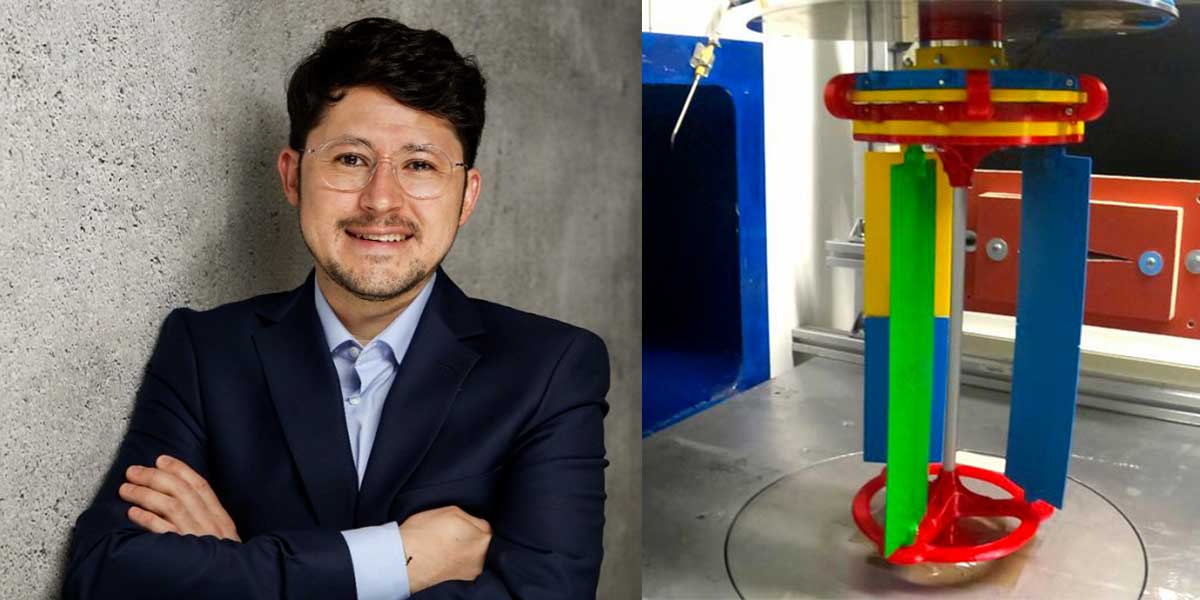
A domestic-use turbine, co-developed in Colombia and Germany, could electrify homes starting in 2024. The story of its creator reflects the challenges faced by inventors in Latin America.
Engineer and entrepreneur Alirio Jiménez Franco has developed a prototype for a domestic wind turbine that can sustainably meet the energy needs of those without access to power grids. It is the Vertical Axis Wind Turbine (TEEV, for its acronym in Spanish). Its design allows it to generate energy from low-speed winds (18 km/h or approx. 11 mph) and operate in both rural and urban environments. Currently, the Colombian inventor is fine-tuning details of the latest prototype in Germany, while seeking investors interested in producing his invention on an industrial scale. This turbine could reach the Colombian and German markets during 2024.
The TEEV was designed to charge the batteries of mobile electronic devices, such as cell phones or computers, in places with little or no access to the electrical grid. Its three blades can adjust their position by rotating on their own axes and spin parallel around the central axis, which is perpendicular to the ground. This allows them to harness wind currents from all directions. Embedded in the turbine’s base, neodymium magnets and copper wire convert the movement into electricity.
Although the turbine cannot yet replace other sustainable energy generators like solar panels, it serves as a complement during the night or on cloudy days. Even so, its use could benefit digital nomads as much as the 2% of Colombian households that, according to the National Administrative Department of Statistics (DANE), still lack electricity. According to the Colombian inventor, homes located near the sea or high in the Andes Mountains could benefit from his turbine.
Transnational Inventor and Entrepreneur
Jiménez left Colombia to settle in Germany, where he secured funding for his turbine. After finishing his studies as a mechanical engineer, the Colombian inventor traveled to Cologne to pursue a master’s program in renewable energy. Years of work in the form of diagrams, blueprints, and ideas traveled with him. Thus, in 2019—five years after conceiving the first version of the turbine—he won the “Business Ideas for Development” call, organized by the German Agency for International Cooperation (GIZ). In the words of David Betancur, a technical advisor for the Migration and Diaspora program at GIZ, “this mechanism is aimed at Colombian men and women who are in Germany, so they can come create companies, generate employment here in Colombia, and contribute to the country’s economic development.”
In addition to receiving funding to complete the TEEV prototype and advice on starting a business, Jiménez was connected with the Tecnoparque Network. This Colombian state technological innovation program supports the development of innovative products. With their support, the inventor built a full-scale prototype. Likewise, he conducted performance tests both in and out of the laboratory. According to Esteban Ocampo, a facilitator at Tecnoparque Rionegro, the goal of these tests is “to measure the turbine’s performance and validate all construction processes so it can be brought to market.” While the testing phase could be completed during 2023, the turbine’s patent certificate is still pending.
Sustainable energy production from renewable sources like wind or sun is a shared interest of the German and Colombian governments. For this reason, the TEEV received support from entities in both countries. Manufactured using 3D printers, most of the turbine’s parts can be made from recycled plastic and reprinted in case of a breakdown. This reduces its carbon footprint while extending its lifespan. Small power generators like this one could counteract the shortcomings in the quality of electricity service that Colombian households receive, without the social and environmental impacts triggered by large-scale installations, such as the wind farms in the Guajira region.
The Challenges of Inventors in Colombia
After 10 years of work, the first TEEV model is close to hitting the market; however, it is impossible to predict exactly when, as Jiménez can only work on it during his free time. “If I could dedicate 100% of my time to it, I could finish it in about two months. But that is a bit utopian because I have to work here to pay my bills; meaning, I work full-time for a company,” the inventor states. Like him, other inventors struggle to balance their jobs with their technological innovation projects in Colombia. Financing the development of innovative products, from conception to industrial-scale production, is, according to Ocampo, one of the main challenges most face.
Like Jiménez, a large portion of inventors in Latin America decide to leave their countries and later register their inventions from abroad. According to the 2022 indicators report by the World Intellectual Property Organization (WIPO), over 80% of patent applications at the Colombian registry office were filed from abroad. Other countries in the region, such as Argentina, Ecuador, Brazil, and Mexico, record similar figures.
You may also be interested
“Plutarchia hildae,” a New Species of Wild Flora, Discovered in Huila
Harpy Eagle Spotted for the First Time in Valle del Cauca During Expedition in San Cipriano
The Colombian Association of Hematology and Oncology (ACHO) Launches the “Avance Hematológico” Journalism Award
First Sighting of the Brown-Breasted Parakeet in Huila, an Endemic Colombian Species