
Harpy Eagle Spotted for the First Time in Valle del Cauca During Expedition in San Cipriano
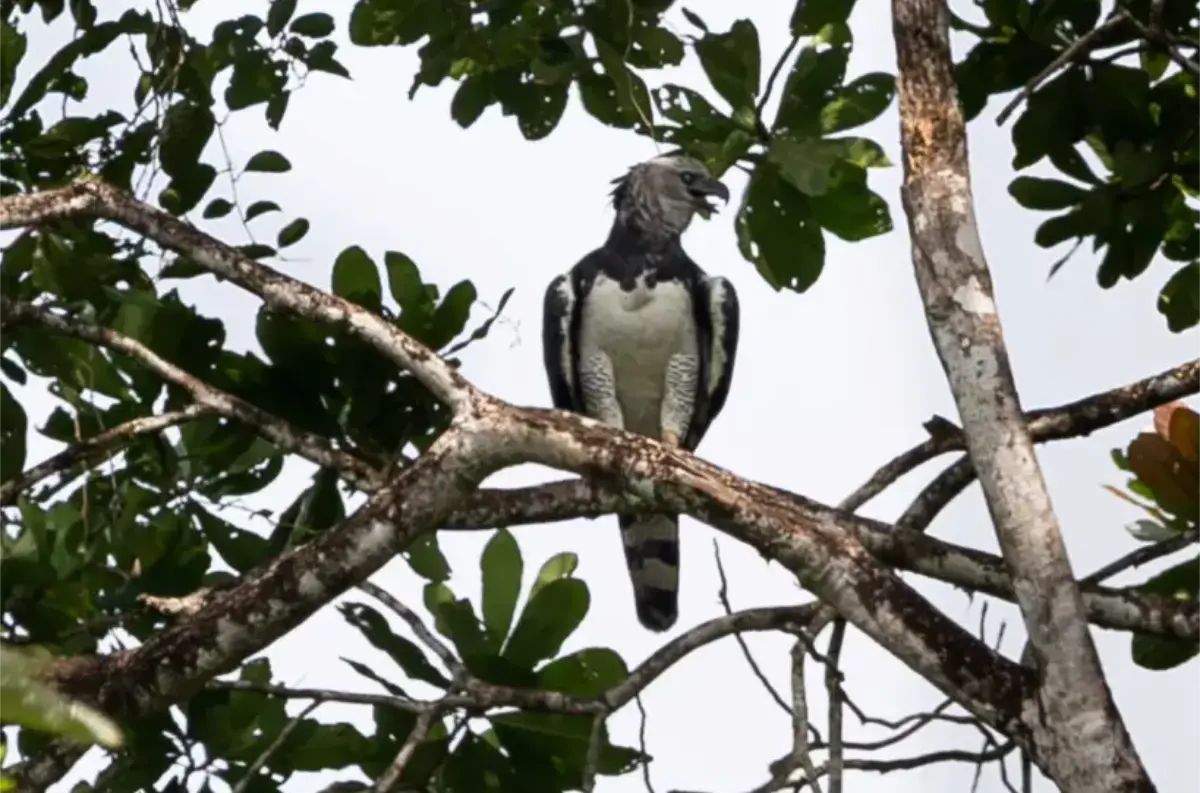
A team from the Valle del Cauca Birdwatchers Clubs Network recorded the presence of the Harpy Eagle (Harpia harpyja) in Valle del Cauca territory for the first time. The discovery, documented with photographic and video material in the San Cipriano and Escalerete Rivers National Protective Forest Reserve, confirms the presence of this bird of prey in the department’s Pacific jungles.
Historic record in the San Cipriano and Escalerete Reserve
The sighting occurred in the town of San Cipriano, municipality of Buenaventura, during an outing carried out by photographers and guides belonging to the Valle del Cauca Birdwatchers Clubs Network, an organization led by the Regional Autonomous Corporation of Valle del Cauca (CVC). The group members—Diego Fernando Mejía, Maribel Rivera, Crhistian Trejos, Leidi Johanna Hidalgo, Javier Roa, and Alejandro Vera—spotted the specimen flying over the area and later perched in the forested strip.
Following the collection of audiovisual material and validation with specialists, the CVC confirmed that the record corresponds to a Harpia harpyja specimen. According to records by biologist Milton Reyes, an expert from the government entity, scientific literature on the distribution of this species in Colombia had limited its reported presence to regions such as Chocó, the Amazon, and sectors of the Orinoquia, with no documented precedent within Valle del Cauca.
The Harpy Eagle is considered the largest bird of prey in the Neotropics and is globally classified as a Vulnerable (VU) species. Adult specimens reach nearly 1 meter in length and approximately 2 meters in wingspan, exhibiting sexual dimorphism where females are larger than males.
Ecosystem conservation status and the value of the discovery
The presence of this species in the jungles of Buenaventura is a response to the availability of mature, continuous forests within the San Cipriano and Escalerete Rivers National Protective Forest Reserve. Due to its status as an apex predator, the Harpy Eagle’s habitat requires vast expanses of forest and large trees that guarantee the subsistence of medium and large prey, such as sloths, anteaters, and deer.
Guide and observer Crhistian Trejos noted that confirming the bird in Valle del Cauca’s Pacific strip serves as an indicator of the conservation status of the local vegetation cover. In turn, photographer Diego Fernando Mejía highlighted the relevance of the discovery for the development of birdwatching in the department, which required field verification among specialist communities before official confirmation.
Recommendations for monitoring and responsible birdwatching
The CVC warned that the species has a slow reproduction rate and high sensitivity to the fragmentation of its environment, factors that increase the vulnerability of its populations. In light of the record’s publication, the environmental authority requested that birdwatching groups and visitors maintain responsible observation protocols in the San Cipriano area.
Biologist Milton Reyes emphasized that monitoring visits must be carried out without disturbing the specimen’s behavior to prevent it from relocating outside the protected area. The institution will continue coordinating tracking efforts with birdwatching networks to strengthen the biodiversity inventory in Valle del Cauca’s ecosystems.
Sources
- Regional Autonomous Corporation of Valle del Cauca (CVC)
- Image credit: Diego Fernando Mejía Navas
You may also be interested
“Plutarchia hildae,” a New Species of Wild Flora, Discovered in Huila
The Colombian Association of Hematology and Oncology (ACHO) Launches the “Avance Hematológico” Journalism Award
First Sighting of the Brown-Breasted Parakeet in Huila, an Endemic Colombian Species
Colombian Butterfly Guide: Download the World’s Largest Photographic Catalog of Butterflies for Free