
The Animero: The Legend and the Tradition
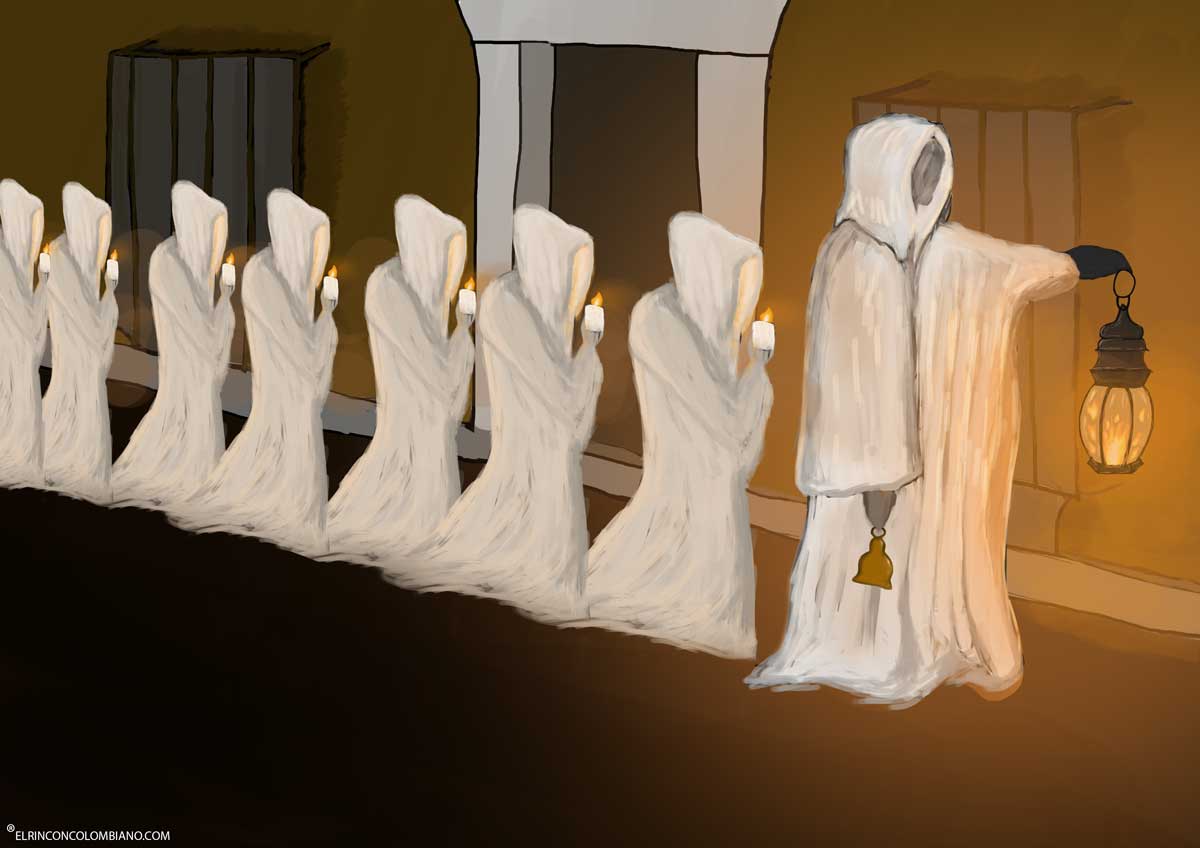
The Animero is a person who has the mission or ability to intercede or mediate for the ánimas (souls in purgatory) so that they receive prayers for their eternal rest.
This curious figure has been linked to Christian-Catholic culture and, due to the ceremonial and mystical nature of the ritual, has become the subject of myths and legends. Today, it is not as popular as it was in the past, when every town had an Animero. There are few towns around the world where this tradition still persists, steeped in legends and mysticism.
(Read Also: Nazarenes in Colombia: A Tradition of Faith, Culture, and Mystery)
In Colombia, there are various tales linked to the figure of the Animero. One of the most renowned legends about this character comes from Mompox, Bolívar.
Legend of the Animero of Mompox
One night in November, the Animero went out on his traditional route through the streets of Mompox. He did so at midnight, accompanied, as always, by his retinue of souls, who joined him in his prayers and pleas to the town for prayers for the eternal rest of the souls in purgatory.
The Animero would stop at every corner, kneel, and loudly request: “A Lord’s Prayer for the souls in purgatory, for the love of God.” He continued down every street and corner, asking for prayers on behalf of the souls. In those times, the entire town respected this tradition and avoided going out to the streets to interrupt the Animero’s work. People went to bed early, and if, for any reason, they were awake when he passed by, they would pray the Lord’s Prayer or a rosary.
(Read Also: Legend of the Headless Priest)
However, a neighbor in the town stayed up all night sewing. When she heard the Animero and the procession passing by, whether out of curiosity or carelessness, she opened the window and came face to face with them. One of the souls stepped away from the group and handed the woman a lit candle; she quickly blew it out and went to sleep. The next day, when she went to check the candle, she found a human shinbone in its place. This terrified the woman and became a warning that the Animero’s work must not be interrupted.
Origin of the Animero Tradition
Although the figure of the Animero has always been linked to the Christian-Catholic tradition, its origins in Latin America also share ties with Indigenous traditions. The cult of the dead is inherent to the customs of these communities, who paid tribute to their deceased through rites and events originating from their culture long before colonization.
(Read Also: Bochica: The Myth of the Muisca Civilizer God)
Following colonization, many traditions intertwined, giving rise to celebrations such as the Day of the Dead. This holiday is most popular in Mexico, but it is also celebrated in other Latin American countries, including Colombia, Ecuador, and Bolivia.
In the Catholic religion, the Animero emerged as a figure who interceded or served as a kind of mediator between the souls in purgatory and the earthly world. In the past, the veneration of souls was highly popular, and people often asked them for favors. Even today, devotion to the “holy souls” persists among a segment of the Catholic community, albeit to a lesser extent. Meanwhile, Animeros have gradually transformed into legendary figures, tourist attractions, or cultural traditions tied to regional identity. Thus, in Latin America, there is a blending of traditions between customs originating in Spain (such as the cult of souls and the Animeros who intercede for them) and the days of the dead, which have their roots in Indigenous culture.
(Read Also: Legend of the Silborcito)
In Spain, in addition to individual Animeros, there were bands of Animeros who roamed the towns playing music. Similarly, in the Canary Islands (Spain), there is a figure known as the Animero, who was considered a kind of healer or medium who exorcised “lingering spirits.” These figures disappeared from the region in the mid-1950s and were always more closely tied to the Aboriginal traditions of the island culture than to the Catholic religion.
Other Legends and Superstitions Linked to the Animero
Every town has its own tales about this character. Besides Mompox, various municipalities in Bolívar also recount the legend of the Animero with different versions. A very popular one comes from the municipality of Margarita, Bolívar.
Legend of the Animero of Margarita, Bolívar
Legend has it that in Margarita and its surroundings, the Animero usually emerges from the cemetery on Good Friday, followed by a procession of souls carrying shinbones in their hands as if they were candles. If they encounter someone along their path, they hand them this “candle,” which turns back into a bone and leaves the person petrified.
(Read Also: The Legend of the Sombrerón)
The only way to break the curse is for a newborn baby to grab the bone. It is said that the Animero of Margarita is seen praying for the souls in purgatory in the streets of this town, followed by his retinue of souls, who appear as transparent figures.
Other Superstitions About the Animero
It is said that the Animero is the only one who can see the souls; this is why he wears a hood, to avoid looking back and seeing all those following him. It is also said that the ritual must be completed before 3:00 a.m.; if it goes past that hour, there is a risk that the souls will remain in the earthly world, causing harm. He has also been attributed the ability to perform miracles at the end of his routes, and it is even claimed that touching his robes guarantees a divine favor.
Where Does the Animero Still Exist?
In Colombia, the tradition persists in municipalities such as Mompox, Sincé, Copacabana, Marinilla, San Roque, and Puerto Berrío. In Ecuador, it also continues in towns like Penipe and Cahuasqui, among others. In Mexico, it survives in similar towns, and in this way, several Latin American countries still maintain this tradition, although it is increasingly disappearing.
What Does the Animero Look Like?
Depending on the country and city where the tradition takes place or where stories about this figure are told, some elements vary. In Latin America, the Animero is usually a man dressed in a white tunic, wearing a hood that covers much of his face, holding a bell in one hand and a cross in the other.
(Read Also: The Legend of Francisco el Hombre)
In other places, the Animero often carries a skull or a rosary in his hand. Sometimes he wears a leather cape, carries a lantern, or dresses in colored tunics.
Since every country, region, and city has its own traditions, it is normal that the Animero has adopted elements specific to the culture of each territory, as well as the idiosyncrasies of those who assume the role.
How to Protect Yourself from the Animero?
As such, the Animero is not an evil being. However, tradition dictates that one should avoid interrupting his rites to avoid being cursed. Likewise, legends warn against going out at night when the Animero is on his route to avoid attracting the souls. If one encounters him face to face, they must begin to pray the Lord’s Prayer.
You may also be interested
The Legend of The Golden Tunjo
The Legend of the Headless Priest
The Legend of La Cabellona Asustada: The Frightened Long-Haired Specter
The Legend of the Breadfruit Tree